

Cold mountain air pressed against his face before sunrise. The world was still blue — not yet morning, not fully night. Dustin stood at the edge of a wooded ridgeline in Georgia, boots damp from the previous day’s rain, fingers stiff as he tightened the straps on his pack. Pine needles shifted in the wind. Somewhere below, water moved over rock. There were no vehicles. No radios. No expectations — just a narrow ribbon of dirt disappearing into trees. He exhaled, shouldered the weight, and stepped forward.
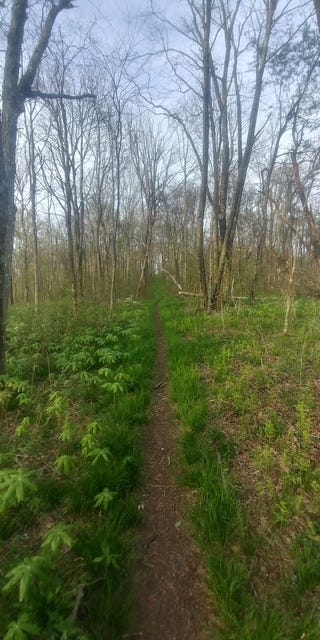
In 2019, Dustin didn’t set out to reinvent himself. He set out to go for a walk.
He had already lived one life, but struggled to figure out what to do next. At nineteen, he joined the Marine Corps — artillery — and spent four years moving through three Marine Expeditionary Units, including time in Japan, Australia, and the Philippines. By twenty-two, he was signing for millions of dollars in equipment and carrying responsibilities most civilians wouldn’t touch for decades. Chaos became familiar. Leadership became instinctual. Pressure was not theoretical — it was lived.
When he separated in 2017, the structure disappeared almost overnight. Civilian life arrived with a new script: get the job, make the money, build stability. Dustin tried. He worked at a brickyard, then attended line school, then joined power line crews across multiple states. He earned decent money. He stayed busy. He did what adulthood required.
But something felt narrow. Dustin describes it now as living inside a box — inherited expectations about success, masculinity, and what life after service was supposed to look like. The military had been a box too, but one that demanded creativity under pressure, shared hardship, and real consequence. Civilian life felt quieter. Smaller. Less alive.
At twenty-six, he felt behind — older than many coworkers, yet at the bottom of the hierarchy. It would take time to realize he wasn’t behind at all. He had chosen to do what less the 1% of the American population would volunteer for — serve his country.
In early 2019, while driving home from work and reflecting on his life choices, Dustin said it out loud: “I’m doing it.” He didn’t know exactly what “it” meant. Only that he needed distance, silence, something unscripted. Within two weeks, he quit his job, bought gear, and stood at the southern terminus of the Appalachian Trail. A route that stretches roughly 2,190 miles from Georgia to Maine.
Dustin did not know it at the time, but the Appalachian Trail would be the first of three major long-distance trails he would complete over the next three years — more than 7,000 miles in total.
The first weeks on the trail were physical: blisters, water-soaked socks, knees that throbbed long after sunset. There were no uniforms. No expectations. No one measuring output — only footfall after footfall, the steady rhythm of movement replacing the noise in his head.
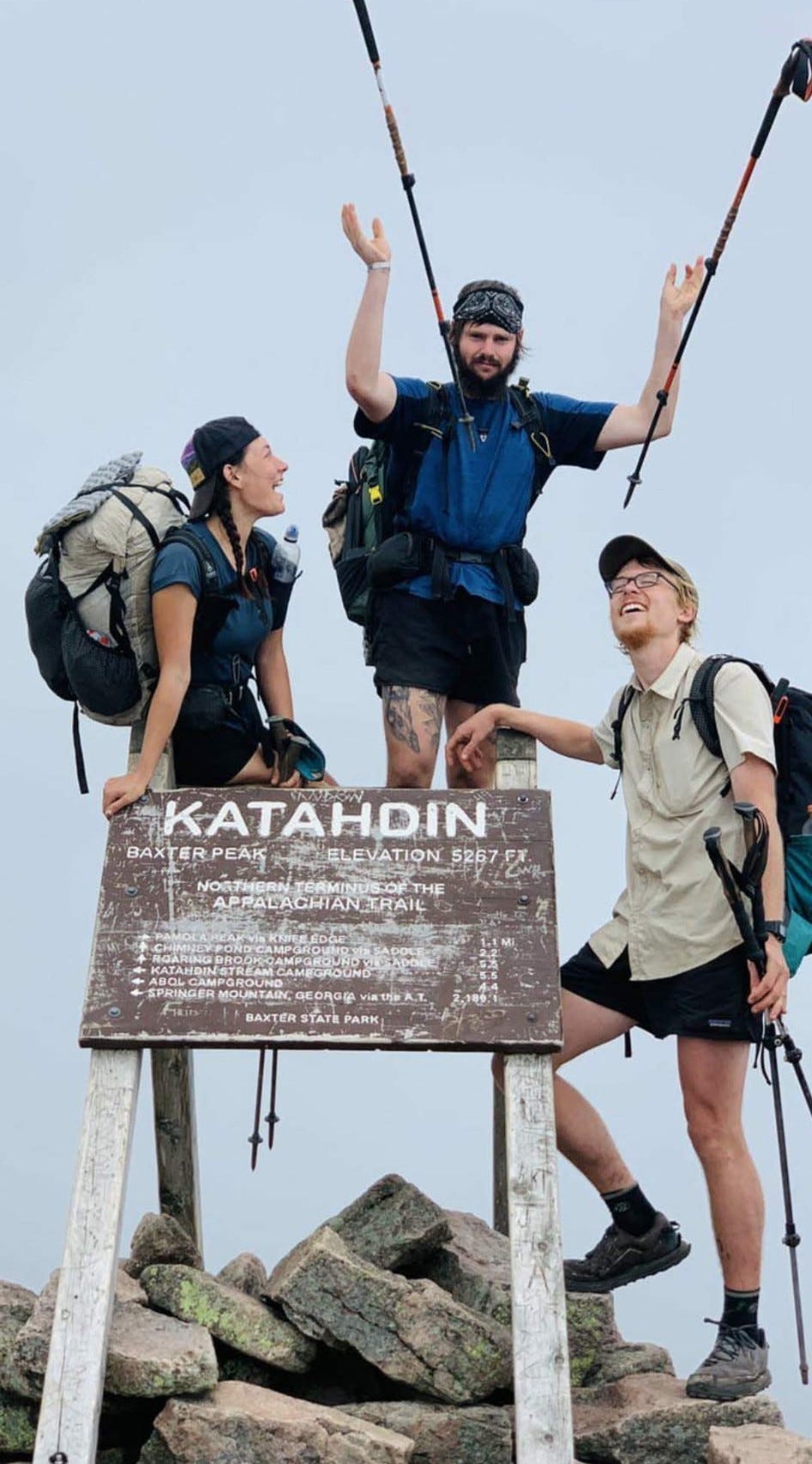
After a month, his body stopped arguing. Twenty miles. Sometimes thirty. Day after day. He didn’t hike to escape his past. He hiked to sit with it. Long stretches of trail gave him time to untangle grief, pressure, and the quiet expectations he had placed on himself. Out there, without performance, identity softened. Something widened. By the time he reached Maine, nothing was magically fixed — but he was steadier.
In 2020, he turned toward the Continental Divide Trail (CDT), a route of more than 3,000 miles tracing the spine of the Rocky Mountains from Mexico to Canada. If the Appalachian Trail was reconciliation, the CDT was confrontation. For weeks at a time, he chose isolation — resupplying briefly in towns before disappearing again into vast, empty stretches of land and sky, including nearly three weeks alone at one point. In that solitude, there is nowhere to hide. You learn what your mind does without distraction — which thoughts fade, which linger, which identities were constructed to survive, and which feel true. The lesson clarified: freedom is not the absence of structure. It is the ability to choose it.


By 2021, he approached the Pacific Crest Trail (PCT) differently. The PCT runs about 2,650 miles from Mexico to Washington. This time, the question was physical: how far can I push my body? He moved quickly, covering most of the trail in eighty-eight days.


When the trail ended unexpectedly, something else emerged — a pattern he describes with grounded confidence. “Shit just works out,” he says, half-smiling. A conversation opens a door to community. A stranger offers a couch to sleep on. A ride appears to get him from point A to point B. Dustin doesn’t describe these events as magical, but they are consistent enough to notice with gratitude. Thru hikers, river guides, wanderers living slightly outside conventional expectations, he found communities that he could relate to.
Only after completing the three major trails did skydiving enter his life. It began as a challenge while seeking personal growth and development. Dustin was encouraged to set a goal he didn’t believe he could accomplish. Within sixty-one days, he earned his skydiving license. In the years since, he has accumulated nearly four hundred jumps. The appeal wasn’t adrenaline alone. It was community. “You come for the adrenaline,” he says. “You stay for the people.” The same was true on the trail.
What Dustin found over those three years wasn’t escape. It was authorship. The leadership forged in the Marine Corps, the resilience shaped through loss, the discipline learned under pressure — he does not try to amputate those parts of himself to fit civilian expectations. He integrates them.
“There is no box,” he says now. “Only the one you put on yourself.”
He doesn’t suggest everyone needs to hike thousands of miles or jump from airplanes. But he believes veterans deserve to know there are more paths available than the ones handed to them — more identities, more ways to live, more ways to serve.
Next, he plans to pursue scuba certification and combine skydiving and diving into the Blue Hole off the coast of Belize.
Air. Earth. Water — not as rebellion, but as expansion.
In 2019, he set out to go for a walk. He didn’t know it would stretch across three years and thousands of miles. He didn’t know it would lead to the sky. He only knew he needed to step forward. The rest unfolded the way trails often do: one deliberate step at a time.